The Software-DefinedModel-BasedIndustrial Base
GEN-C4
Industrial Command for Hyper-fast Disruption, Renewal, and Sustained Advantage
From operational need to fielded system in hours instead of years
C5ISR for the defense industrial base
GEN-C4 is an industrial command architecture that brings C5ISR to the defense industrial base—accelerating disruptive capability development, industrialization, and production at scale while driving force modernization and industrial reconstitution to sustain overmatch.
Designed for
Incremental progress, not big-bang transformation
Adoption starts with one buyer, a few producers, and existing equipment. Each increment unlocks a capability and earns the next.
Ground-up development of national capability
Capability grows firm by firm, process by process. Each investment targets the next missing ingredient; proven processes replicate.
Participation without surrendering systems or secrets
Firms keep their own tools and models. Only the meaning at the interface is standardized; proprietary parameters stay private.
An industrial base open to new players
Fabless defense firms, specialist processors, shared facilities, and lifecycle services each gain a defined role and a path to compete.
The entire life cycle
From development to retirement and reuse, one connected undertaking. Repair, retrofit, and salvage compete with new builds.
Self-healing and self-reinforcement
The process that delivers systems also restores and improves the means of production: capability that builds capability.
Judging the whole route, not just the design
Designs are weighed with producers, capacity, logistics, acceptance, and financing. Infeasible routes surface before commitment.
Money that moves with the work
Authority, funding, milestones, acceptance, and payment stay tied to physical progress, making commitments financeable and traceable.
Change that costs the adversary more
A modest change can force costly integration and preparation on the other side, while GEN-C4 keeps capacity for the next move.
Operation when links fail
Released work continues through outages under agreed rules. Records reconcile on reconnection; contingencies enable surge.
Proven knowledge that carries across change
Maintained process evidence replaces repeated qualification. A changed material, machine, or design needs new work only at the gaps.
Answers that state their limits
Every answer states its scope, evidence, and uncertainty. Unsupported requests get explicit answers instead of silent assumptions.
Human authority over AI
AI generates and evaluates alternatives at machine speed. Engineers and designated authorities keep the judgments and approvals.
Discovery beyond current knowledge
Unknowns go to a connected research system. Findings return as usable engineering knowledge, kept apart from unproven claims.
Advantage when rivals have the same technology
Tools spread; maintained knowledge, skilled people, assets, and commitments do not. The design assumes adversaries build a GEN-C4.
Hyperfast at every stage of every system’s life
Speed that ends at the prototype is a sprint. GEN-C4 is designed to bring the same speed to every action that follows, from first build to final salvage.
01Build
New systems
From requirement to accepted delivery, built from proven building blocks.
Variants
Changed requirements assessed against proven knowledge; only real gaps need new work.
Export variants
Versions for allies derived from the baseline, with releasable scope defined up front.
Surge
More output from prepared capacity and additional producers under standing agreements.
Second-source qualification
A new producer proven against existing evidence, not a fresh qualification campaign.
Production restart
A closed line reopened from retained designs and process evidence.
Restored production
A lost machine or supplier answered with repair, transfer, substitution, or a new asset.
02Sustain
Spare parts
Made by any qualified producer, or redesigned when the original source is gone.
Lifetime and bridge buys
Last-time buys sized from real demand and fleet plans, before the source disappears.
Obsolescence resolution
Vanishing parts replaced or redesigned before shortages ground the fleet.
Repair
Function restored from known condition and evidence, weighed against replacement.
Battle damage repair
Field repairs assessed against known limits, returning damaged systems to the mission.
Depot overhaul
Teardown, inspection, and rebuild planned from each unit’s actual condition.
Reset
Equipment returning from deployment restored to standard on a known workload.
Safety and airworthiness fixes
Affected units identified across the fleet; fixes issued and tracked to return to service.
Munitions recertification
Stored munitions assessed for shelf-life extension from test evidence and storage history.
03Modernize
Retrofit
Approved changes carried back into fielded units, each matched to its actual configuration.
Upgrade
New capability added, with power, cooling, and interface effects visible up front.
Software and mission data
Flight software, threat data, and security patches fielded with known effects.
Technology refresh
Aging electronics and computing replaced on a planned cadence, not when they fail.
Re-engining and re-winging
New engines or wings integrated, with effects across the airframe known in advance.
Conversion and re-role
Existing platforms given new missions, reusing what still serves.
Service life extension
Platforms run past design life on evidence of remaining structural and component life.
Recapitalization
Units rebuilt to near-new or to a newer model, reusing what remains sound.
04Retire
Storage and regeneration
Stored aircraft, ships, and vehicles returned to service from a known preserved state.
Parts reclamation
Serviceable parts drawn from stored and retired units before working ones are cannibalized.
Salvage into new platforms
Recovered components enter new systems carrying their history and evidence.
Transfer to allies
Surplus equipment handed over with its configuration, records, and support intact.
Demilitarization and disposal
Weapon-capable features removed and materials recovered, with every unit accounted for.
An industrial base that integrates itself, from the ground up
Integrating the industrial base from the top down would take decades. GEN-C4 takes the ground-up route: each undertaking connects the firms it needs through common interfaces, and the base integrates itself as that work accumulates.
Standardize the promise, not the factory
Interfaces, not implementations
GEN-C4 defines what each participant must answer, prove, and commit to. Tools, systems, and methods stay the participant’s choice.
Every interface states its conditions
What it needs from its surroundings, such as loads, tolerances, power, timing, and data meaning, and what it delivers when those hold.
Competence behind every interface
A connector proves nothing. An interface counts only when real capability and evidence stand behind it.
Command outcomes. Let capability compete.
Outcomes before resources
Required work is stated with its conditions before any machine, site, or supplier is chosen, so every capable resource can compete.
Keep alternatives alive
Substitutes are designed in, and decisions that would lock in a process or supplier stay open until they must close.
An industrial base that composes like software
Compose from proven parts
Items are defined for reuse across systems, with permitted connections and supported variations. New systems are assembled, not drawn from scratch.
Extend existing standards
SysML, STEP, AAS, OPC UA, and ISA-95 come first; new language only where they fall short.
Every interface has an owner and a version
Mappings are maintained work. A named owner assesses, demonstrates, and transitions every change.
Unity at the interface, freedom behind it
Name every state
An estimate is not a reservation, a reservation is not an obligation, and shipped is not accepted. Facts, forecasts, and unknowns stay distinct.
Change without erasing history
Every change names what it supersedes, and past work keeps the baseline it was done under.
Command without a command center
Every instance is a whole GEN-C4
Any vendor can run all five functions, Command, Generation, Coordination, Control, and Capability, within its own business scope, across its own suppliers and partners.
Participants join as they are
No enterprise, IT, or maturity transformation is required. Suppliers and partners take part with the systems and people they have today; GEN-C4 carries the complexity.
Ecosystems connect as peers
Instances combine into larger ones through the same interfaces, with no center above them.
Owners keep control of their assets
Running GEN-C4 gives no one control over the factories, machines, or capacity it coordinates.
Modern battlefield adapts in weeks. But conventional acquisition delivers in years.
Ukraine shows what industrial speed looks like when war forces it: countermeasures revised in weeks, drones delivered by the million, front-line units ordering directly and receiving in days. Major U.S. programs measure delivery in years.
6–12 weeks
Before Russian forces can jam or spoof a drone’s control methods. Near specialized counter-drone systems, about two weeks.
10 days
Average order-to-delivery when Ukrainian brigades buy drones directly through the DOT-Chain Defence marketplace.
12+ years
Average time to deliver initial capability across major U.S. weapon programs, and rising.
36,000
U.S. 155mm shells produced per month in March 2026, against a goal of 100,000 a month by October 2025.
Delaying GEN-C4 adoption costs more than the time lost
Industrial capability compounds. Each undertaking leaves designs, process evidence, trained people, and working relationships that make the next one faster, and unit costs fall by a steady share with every doubling of cumulative output. Each producer that joins adds routes for every buyer; each buyer adds demand for every producer.
Both effects build on what already exists, so early differences grow instead of fading. A head start of months can become a gap of years in what an industrial base can design, build, repair, and replace. The side that starts building GEN-C4 capability first sets the pace for the side that follows.
| Share of period | Early start | Delayed start |
|---|---|---|
| 0% | 0 | 0 |
| 20% | 3 | 1 |
| 40% | 9 | 5 |
| 60% | 22 | 13 |
| 80% | 47 | 30 |
| 100% | 100 | 64 |
From strategic vision to implementation planning
Winspyre aims to commercialize GEN-C4 as one integrated package.
- Vision
- The future-state capabilities: rapid disruption, production at scale, and renewal of the means of production.
- Strategy
- Intelligent approaches that simplify transition, create virtuous cycles, and sustain advantage over equally capable adversaries.
- System architecture
- Generation connected with Command, Coordination, Control, and Capability across the full lifecycle.
- Transition design
- An engineered path from current practice: a minimum viable start, then each increment chosen by the capability it unlocks.
- System development
- Built on Winspyre’s proprietary systems for transforming industrial enterprises into intelligent systems.
- Ecosystem expansion & maturity development
- More producers, suppliers, and service providers brought in, with depth built where missions need it most.
- Implementation planning
- Plans that align capability development, industrial mobilization, and production reconstitution.
- Program management
- Managing the national GEN-C4 program: mandate, architecture governance, certification, participation funding, and expansion.
Proven in industry first
GEN-C4 builds on Winspyre’s commercial systems, which transform industrial enterprises into self-optimizing intelligent systems and automatically collapse data-to-outcome from months to hours across all enterprise functions: R&D, product management, sales, finance, procurement, supply chain, operations, HR and IT.
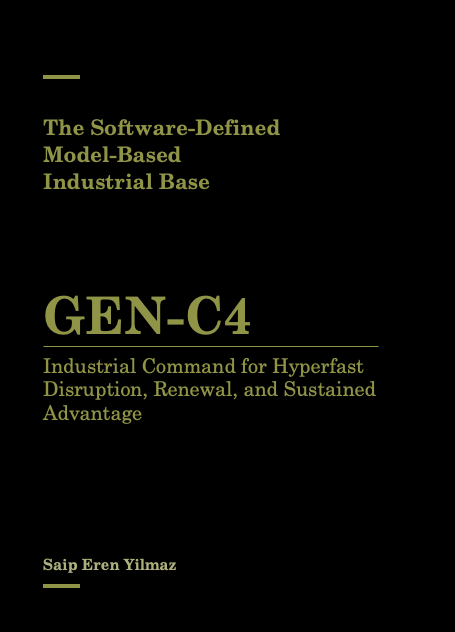
Industrial Command Capability at National Scale
Saip Eren Yilmaz presents GEN-C4 as an industrial doctrine and architecture for turning national industrial power into sustained strategic advantage. The book explains GEN-C4’s foundations and operation, illustrates the architecture through concrete scenarios, and develops practical strategies for incremental transition. The book also examines how to sustain advantage against adversaries possessing comparable GEN-C4 capabilities.
Ask about the bookFrom Manufacturing Cloud to GEN-C4
The Air Force Research Laboratory’s (AFRL) Endless Forge program points toward a vision for a responsive, distributed, and rapidly scalable defense industrial base.
Winspyre launches its industrial intelligence solution, which transforms global industrial enterprises into intelligent systems.
Saip Eren Yilmaz submits the Manufacturing Cloud: Software-Defined Industry concept to the U.S. Air Force and Space Force.
AFRL announces Endless Forge.
- Since then
Yilmaz’s pursuit of Endless Forge develops the earlier concept into GEN-C4.
- Today
Winspyre aims to commercialize GEN-C4, and the book Industrial Command Capability at National Scale sets out the doctrine and the architecture.
GEN-C4 remains Saip Eren Yilmaz’s independent architecture and strategic vision and is based on Winspyre’s proprietary systems for transforming industrial enterprises into intelligent systems.
Request a GEN-C4 briefing
Write to Winspyre to arrange a briefing on the architecture, its transition strategies, and implementation planning.